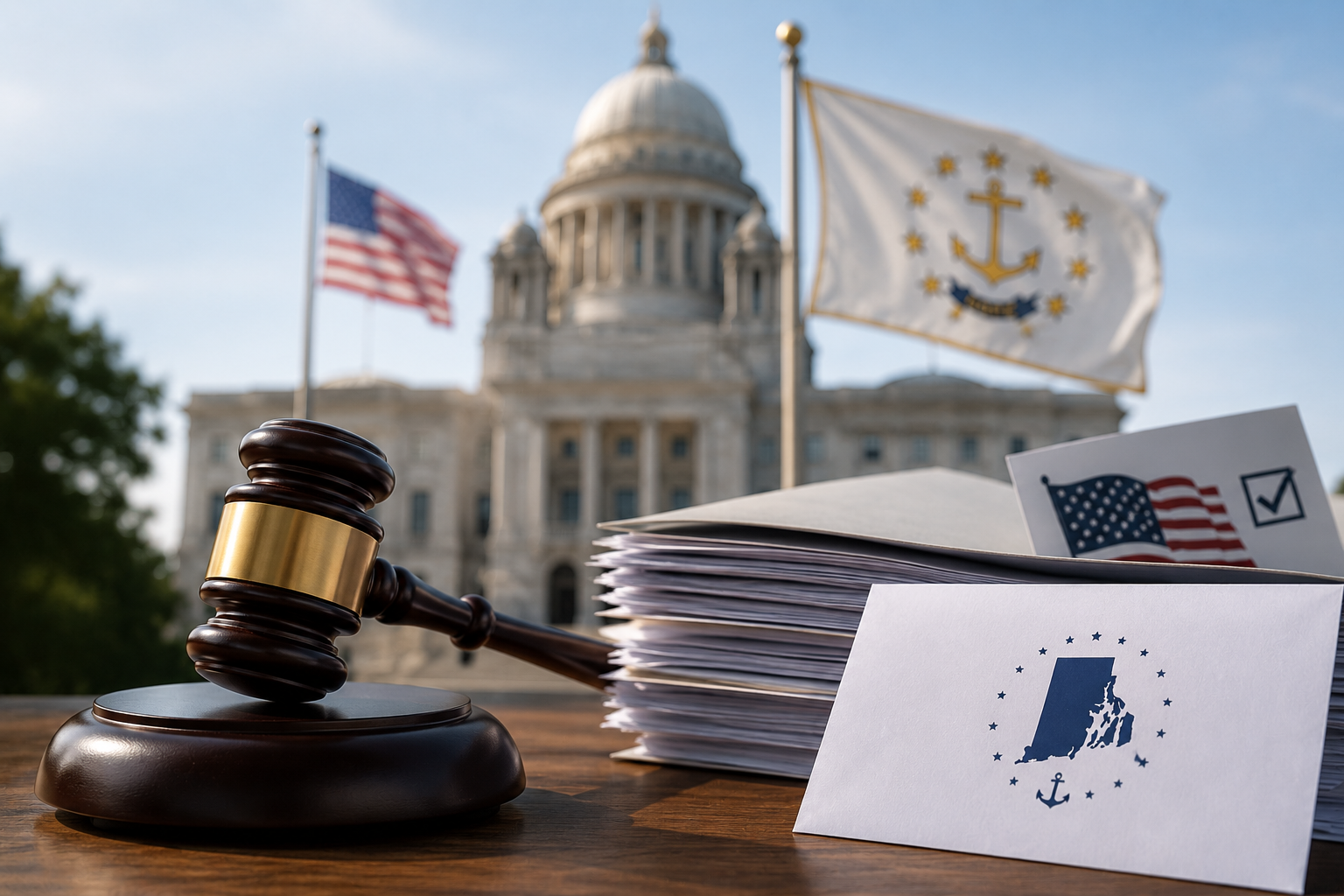
Rhode Island won the first major court ruling in its voter data lawsuit. A federal judge dismissed the U.S. Department of Justice’s case on April 17, 2026. DOJ wanted an unredacted copy of Rhode Island’s voter registration database, which held private details such as birth dates, driver’s license numbers and partial Social Security numbers. Judge Mary S. McElroy ruled that federal officials had not shown a valid factual reason for such a broad request. DOJ later filed an appeal, so the legal dispute remains active as of July 2026.
This case is not about secret ballots or individual voting choices. It focuses on who can access sensitive voter records and what legal proof a federal agency must provide before a state releases them. Rhode Island offered the public version of its voter list but refused to hand over confidential fields. That refusal created a wider debate about voter privacy, election security and federal power.
How the Voter Data Fight Began
U.S. Attorney General Pam Bondi asked election officials across the country to provide complete electronic copies of their voter registration lists. Rhode Island received the request in September 2025. DOJ said it needed the data to review compliance with federal election laws and check the accuracy of state voter rolls. Secretary of State Gregg Amore offered the public version of Rhode Island’s voter list but kept protected personal details hidden.
Federal officials demanded the complete file without redactions. Amore refused because the request covered sensitive data and did not show clear proof that Rhode Island had broken any law. DOJ filed United States v. Amore on December 2, 2025, in the U.S. District Court for the District of Rhode Island. DOJ treated the request as part of its election enforcement work, but Rhode Island viewed it as an unsupported attempt to collect private voter information.
Records DOJ Asked Rhode Island to Share
Rhode Island stores voter details in a statewide electronic database that election officials use to confirm registrations, update addresses and manage voter status. DOJ requested a complete unredacted copy of that file. Court records said it could include full birth dates, home addresses, driver’s license numbers and the last four digits of Social Security numbers for nearly 750,000 registered voters.
The database does not reveal which candidate a person supported because ballots remain secret. However, the private identifiers inside the file could create privacy and security risks if they were shared, stored or used beyond their original election purpose.
| Voter record field | General access status |
|---|---|
| Name and voter registration status | Often part of the public voter list |
| Home address | May appear under state access rules |
| Full date of birth | Usually restricted or partly hidden |
| Driver’s license number | Private personal information |
| Social Security number digits | Private personal information |
| Voting history | May show participation, not ballot choices |
Concern grew because DOJ lawyers said the department planned to share data with the Department of Homeland Security to check citizenship records. Critics feared errors could place lawful voters under suspicion or lead to incorrect removal efforts. DOJ argued that such checks could help officials find inaccurate records and protect election integrity.
Rhode Island’s Reason for Protecting Private Voter Data
Amore’s office said DOJ had not shown any clear problem with Rhode Island’s voter rolls. Federal officials did not identify an ineligible voter, a pattern of duplicate records or a failure in the state’s list process. Rhode Island also had a duty to protect confidential details that voters provide during registration.
State officials said DOJ could investigate a claim backed by evidence, but it could not search through private records without a clear reason. Civil rights groups, labor organizations, retired residents and individual voters supported Rhode Island, warning that the release could expose personal data and weaken trust in the election system.
Federal Laws at the Center
DOJ based its request mainly on Title III of the Civil Rights Act of 1960. That law allows the attorney general to seek election records during a voting-rights investigation, but the request must explain its legal purpose and factual basis. DOJ claimed this authority covered Rhode Island’s full voter database.
Judge McElroy disagreed and said a reference to federal law was not enough without facts that pointed to a possible violation. DOJ also cited the National Voter Registration Act and the Help America Vote Act, which require states to maintain accurate voter rolls. The court found that neither law gave federal officials automatic access to every private field in the state database.
The Judge Found DOJ Lacked Evidence
Judge Mary S. McElroy found that DOJ’s request did not explain a clear factual basis. Federal law required the agency to state both the reason and purpose behind its demand, yet DOJ only said it wanted to review Rhode Island’s compliance with election laws.
The court said a legal citation alone could not support access to private voter records.. Federal officials needed facts that pointed to a possible violation. McElroy described the request as a “fishing expedition” because DOJ wanted to search the full database without first showing evidence of a problem.
Judge denied DOJ’s attempt to force Rhode Island to release the file and dismissed the lawsuit. Her ruling did not confirm that every voter record was correct or block a future investigation. It only found that this request lacked enough factual and legal support.
No Finding of Faulty Voter Rolls
The court did not find that Rhode Island’s voter rolls were inaccurate or filled with unlawful registrations. DOJ also did not present strong evidence of noncitizen voters, duplicate records or failed list maintenance. The case focused on a narrower issue: whether federal officials had shown enough reason to access the private data of nearly 750,000 voters.
Rhode Island still has a duty to remove outdated records and correct errors when voters die, move or appear more than once. At the same time, residents deserve to know that their personal details will not be handed over without a clear legal reason. Accurate elections and voter privacy should support each other, not compete with each other.
Rhode Island Voter Data Lawsuit Timeline
This timeline shows how the dispute moved from a federal data request to an active appeal.
| Date | Key development | Official proof |
|---|---|---|
| September 8, 2025 | DOJ asked Secretary of State Gregg Amore for an unredacted copy of Rhode Island’s statewide voter registration list. | Federal court order |
| September 16, 2025 | Amore offered the publicly available voter list but refused to release protected personal information. | Federal court order |
| December 2, 2025 | DOJ filed United States v. Amore and asked the court to force Rhode Island to provide the complete file. | Official DOJ announcement |
| March 26, 2026 | The federal court held a hearing on DOJ’s request and the motions to dismiss the case. | Federal court order |
| April 17, 2026 | Judge Mary S. McElroy rejected DOJ’s request and dismissed the lawsuit. | Official dismissal order |
| June 2026 | DOJ appealed the dismissal to the U.S. Court of Appeals for the First Circuit under case number 26-1665. | Official First Circuit docket |
| Status checked July 14, 2026 | No final appellate ruling had been issued, so the district court dismissal remained the main decision in the case. | First Circuit appeal docket |
The Case Moved to Federal Appeal
DOJ appealed the decision in June 2026 and moved the case to the U.S. Court of Appeals for the First Circuit. Federal lawyers argued that Judge McElroy placed limits on the Civil Rights Act that do not appear in the law. DOJ also asked the court to speed up the appeal before the 2026 federal elections, but Rhode Island and the groups involved in the case opposed that request.
The First Circuit can uphold the dismissal, reverse it or return the case to the district court. Its decision may also affect similar voter-data disputes in other states. No final appellate ruling had been issued as of July 14, 2026, so the district court’s dismissal remains in place, but the legal fight is not over.
What Does This Lawsuit Mean for Rhode Island Voters?
Rhode Island residents do not need to register again. The case has not cancelled registrations, changed party records or affected ballot secrecy. Its main concern is the possible release of private details such as addresses, birth dates and identification data.
A final ruling could shape future federal requests. DOJ may gain wider access to voter files, or courts may require stronger proof before states release protected records.
Residents can take a few simple steps:
- Check voter status through Rhode Island’s official voter portal.
- Contact a local election office if any detail is wrong.
- Avoid unofficial sites that request sensitive information.
- Follow official court or state updates.
- Report suspicious messages that ask for voter data.
A Decision That Could Affect Voter Privacy Across America
DOJ sent similar voter-data requests to several states and sued those that refused to provide complete files. Rhode Island’s case now forms part of a wider dispute over how far federal election power should reach. States manage voter records, but federal officials also enforce election laws. Tension grows when both sides disagree over access to private information.
A final appeals court ruling could set clearer limits for future requests. It may explain what proof DOJ must provide before a state releases protected voter data. This matters because national record checks may find errors, but large data transfers can also expose personal details, create false matches and weaken public trust.
Where the Case Stands Now
Rhode Island voter data lawsuit tests a basic limit on government access to personal information. DOJ asked for a complete state voter file with confidential fields. Rhode Island offered public records but refused to release protected details without a clear factual and legal reason.
Judge Mary S. McElroy agreed with Rhode Island and dismissed the federal case on April 17, 2026. Her ruling said DOJ could not use federal election law to search through private records without facts that pointed to a possible violation.
Appeal now gives the First Circuit a chance to define federal authority in greater detail. Outcome may affect voter privacy, state control of election records and DOJ investigations across the country. Rhode Island voters remain registered, ballots remain secret and the dispute continues in federal court.
Common Questions
The lawsuit centers on DOJ’s request for an unredacted copy of Rhode Island’s statewide voter registration database. Rhode Island shared the public version but withheld protected details such as driver’s license numbers and partial Social Security numbers.
Rhode Island won at the federal district court level on April 17, 2026. Judge Mary S. McElroy dismissed the case after finding that DOJ had not provided enough factual support for its demand.
Secretary of State Gregg Amore offered DOJ the voter list available under Rhode Island’s public records process. The dispute involved confidential fields that were removed from that version.
Voter records may show registration status, district details and whether a person took part in an election. They do not reveal which candidate or measure a voter supported.
DOJ appealed the dismissal to the U.S. Court of Appeals for the First Circuit in June 2026. No final appellate ruling had been issued as of July 14, 2026.
Disclaimer: LawMonarch’s team of 5+ legal writers and researchers carefully reviews each article to provide clear and accurate information. This content is for general information only and does not replace legal advice from a qualified attorney.