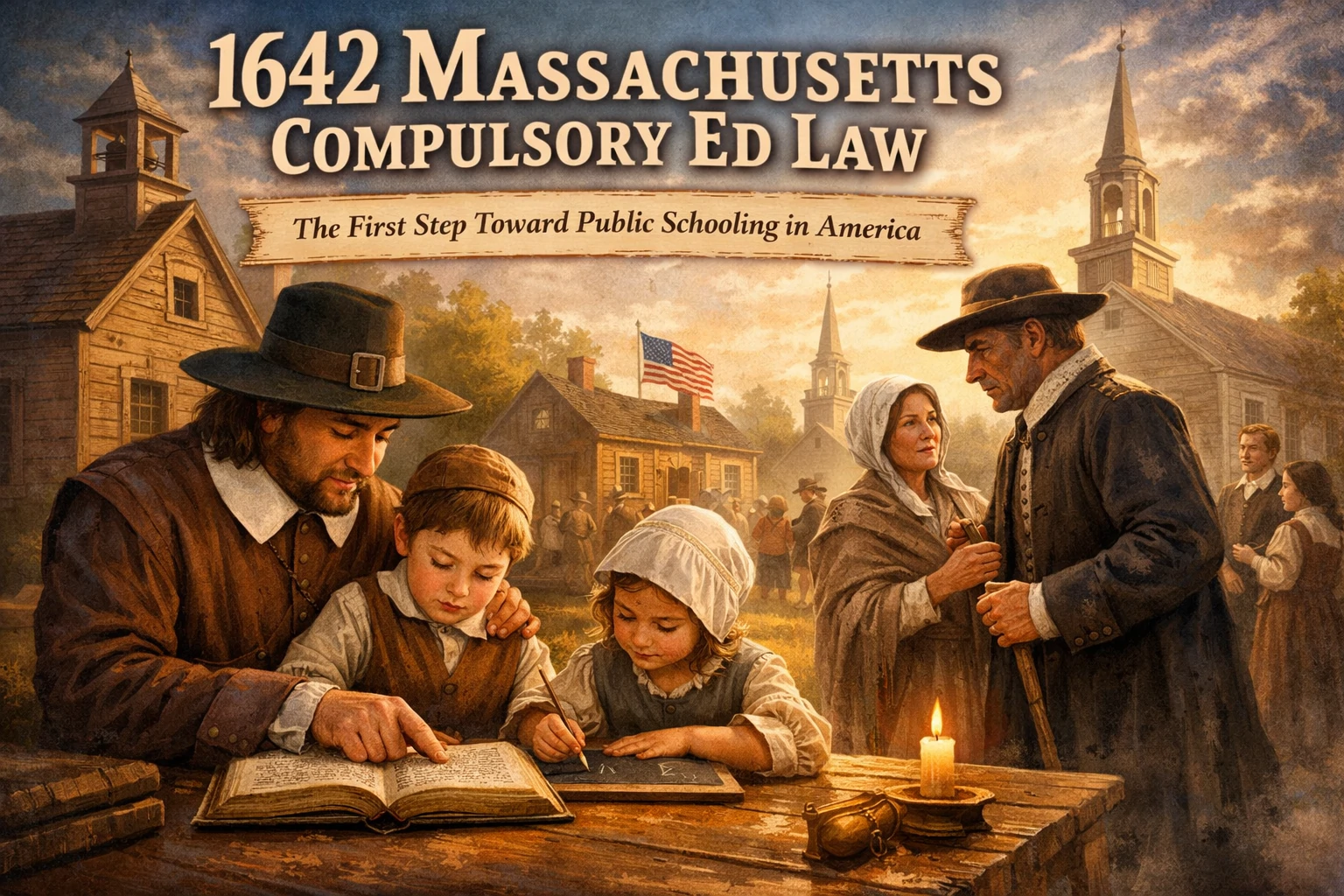
Most people think public education began with big schools and set rules. But its roots go back much earlier. In 1642, the Massachusetts Bay Colony passed a simple law. It did not build schools. It gave no money. It told parents to teach their children. If they failed, the town could step in.
The colony was still new. Towns were small. Supplies were few. But leaders believed one thing, every child should learn. They linked reading to faith and order. They believed children must know how to read the Bible and follow the law.
The law gave towns power to check on families. Parents had to teach basic skills. If they did not, local leaders could act. That idea may seem normal now. Back then, it was bold.
This law marked a clear shift. It made learning a duty, not a choice. It laid the base for future schools and education laws. It was a small rule but it changed everything.
Table of Contents
ToggleWhat Did the 1642 Law Actually Say?
The text of the law was short. It used plain English. It focused on family duty, not government power. The law said that parents and masters must ensure their children could read and understand the principles of religion and the laws of the land.
The law did not tell towns to hire teachers or create buildings. It did not set schedules or grades. It only placed responsibility in the home. The leaders of the colony believed parents and masters (those in charge of apprentices or servants) must take education seriously.
If they did not, the selectmen the local leaders of the town had the right to act. They could question families. They could investigate. They could punish neglect. This shift meant the government had a role, even if small, in childhood learning.
Why Did the Massachusetts Bay Colony Create This Law?
The Puritans founded the colony with strict religious goals. They believed in a direct link between literacy and salvation. If a child could not read the Bible, their soul might be at risk. That belief shaped laws, family life, and schools.
The law also came at a time when English ideas about education were changing. In England, education was still mostly for the rich. In Massachusetts, people wanted a broader system. They needed citizens who could read laws, obey rules, and teach the next generation.
Another reason involved crime and poverty. Leaders feared what might happen if children grew up uneducated. Without skills, they might become a burden. Or worse, they might turn to crime. The law tried to stop that before it started.
Role of Parents Under the 1642 Law
This law made parents the first teachers. They had to teach their children or find someone who could. The colony expected every parent to understand their duty. This meant more than just reading and writing. It included religious training and moral lessons.
If a child did not learn, the parent faced blame. If a servant remained ignorant, the master stood responsible. This rule placed heavy pressure on adults. It linked family success to public duty. Parents were not just raising children they were shaping citizens.
The law made it clear that homes mattered more than schools. Even today, that idea survives. Many modern debates still ask where learning should start: at home or in school?
Role of Towns and Selectmen
Though the law focused on families, towns had a role too. Selectmen had the power to check on families. They could ask if children could read. They could check if boys and girls understood religion and law. If not, the selectmen had to act.
This gave local leaders a new kind of job. They became part of the education system. Not as teachers, but as overseers. Their job was to protect public knowledge.
This power created tension. Some parents saw it as government control. Others accepted it as a duty. Either way, it marked a shift. The government now cared what children knew.
No Schools, Yet Still a System
The 1642 law did not create schools. But it did create a system. It said that children must learn. It gave towns the right to make sure learning happened. It made education a public concern, not just a private task.
- Most homes had Bibles.
- Many parents knew how to read.
- Some taught letters, numbers, and prayers.
- Wealthier families hired tutors.
- Poorer families turned to church leaders.
| 1642 Law | 1647 Law |
|---|---|
| Focused on family responsibility | Required towns to hire teachers |
| Gave towns oversight power | Required schools in towns over 50 people |
| Did not create schools | Started public school structure |
| Education stayed in homes | Education moved to classrooms |
| Enforced through selectmen | Enforced by schoolmasters and town rules |
In time, this system needed more. That need led to the next major law, the 1647 Massachusetts School Law…
The Link Between Literacy and Religion
Puritan beliefs shaped early laws. They saw reading as a holy act. A person had to read the Bible to understand God. That belief drove the 1642 law. It made reading a moral duty.
Church leaders preached about it. Families prayed over it. Parents felt pressure to raise good Christians. That meant literate children. Ignorance was not just a weakness, it was a sin.
This view helped build early support for public education. People saw schools not as a luxury but as a path to heaven. Laws followed that logic.
Teaching Basics to Build a Future
Religion drove much of the early education push. But civic life also played a role. Leaders knew the colony needed good citizens. That meant people who understood laws, followed rules, and helped others do the same.
Children needed to know how the colony worked. They needed skills to find work, pay taxes, and serve in the militia. That need shaped the law too. It was not only about souls, it was about survival.
The colony feared disorder. Education became a tool to prevent chaos. If children knew right from wrong, society had a chance to grow strong.
Impact on Servants and Apprentices
The 1642 law did not just target parents. It also applied to masters. In that time, many children lived as servants or apprentices. These young people worked in homes, shops, or farms. They needed protection.
The law said masters must teach their charges. They had to provide reading lessons and moral training. If they failed, they faced punishment. This part of the law showed how seriously the colony took education. Even working children had a right to learn.
This helped spread literacy. It also protected poor children from total neglect. It gave them a chance to rise through knowledge.
Masters Had to Teach Servants Too
Before this law, education was seen as a private task. Parents did what they could. Some taught their children. Others did not. No one forced the issue. The 1642 law changed that. It made education a duty, not a choice.
The law marked a shift in how people saw children. They were not just workers or future adults. They were learners. They had value. Their minds mattered.
This idea changed how towns worked. It made schools possible. It made laws about education seem normal. Without this early step, later reforms would have failed.
How This Law Shaped the Nation
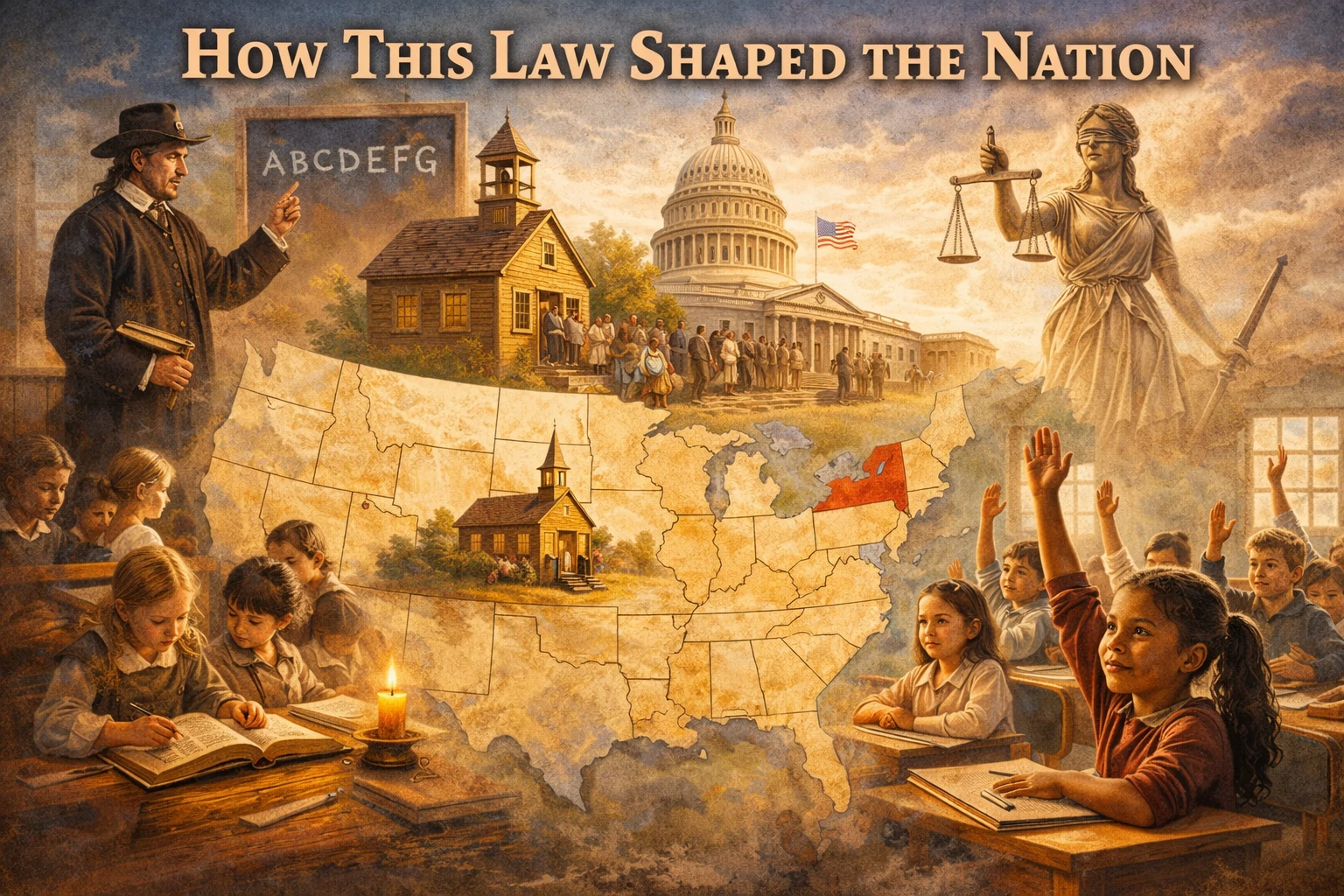
The 1642 Massachusetts law may seem small now. But its impact was huge. It set the tone for future laws. It showed that government had a role in learning. It gave power to families and towns. It said children mattered.
Later laws added more rules. They built schools. They hired teachers. They created grades and tests. But none of that would have worked without this first step.
The law also shaped how Americans view education today. It taught people that reading was not just a skill, it was a right. And it proved that learning starts at home, but must be shared by all.
Comparison with 1647 Massachusetts School Law
Five years later, in 1647, the colony passed a new law. This one required towns to create schools. If a town had 50 families, it had to hire a teacher. If it had 100 families, it had to build a grammar school.
This law built on the 1642 foundation. It expanded the idea. It turned home education into public schooling. The two laws worked together. One focused on duty. The other focused on delivery.
Without the 1642 law, the 1647 law might have failed. People needed to understand why schools mattered. That first step helped the second one work.
Some Families Ignored the Law
Even with the law in place, not every family followed it. Many homes lacked books. Some parents could not read themselves. Others simply did not care or lacked the time. Selectmen faced hard choices. Should they punish struggling families? Or offer help?
Records from the time show mixed results. Some towns took the law seriously. Others ignored it. Some leaders checked every child. Others stayed silent. These uneven results show the law’s limits.
Still, the law sent a message. It told families that learning mattered. It gave towns a reason to act. And it helped set a pattern that would grow stronger with time.
Seeds of Modern Education Policy
The 1642 law planted ideas that still shape modern schools. First, it linked education to public interest. A child’s learning affected everyone. Second, it called on the government to step in when families failed. That laid the path for school boards and education departments.
Third, it focused on basic skills. The law stressed reading, religion, and civic understanding. These subjects still form the core of early education today.
The law also gave a new role to local leaders. Selectmen became the first education inspectors. Their job later grew into full-time school roles.
Children Were Seen in a New Light
Before the 1600s, most people saw children as small adults. They worked, obeyed, and helped the family survive. But the 1642 law saw something else. It treated children as minds to shape. It said they had value beyond chores.
This shift mattered. It laid the groundwork for child rights, school access, and laws against child labor. The idea that all children should learn slowly took hold.
This law helped turn that belief into policy. It gave legal weight to a moral idea. Children were not just family assets they were future citizens.
Influence on Other Colonies and States
Massachusetts led the way, but others followed. Connecticut, New Haven, and Plymouth passed similar laws. Later, other colonies adopted parts of the Massachusetts model. After independence, many states built their education codes on it.
In time, the U.S. Constitution left education to the states. But the ideas from Massachusetts spread everywhere. Each state passed its own version of compulsory education. Each one owed a debt to those five lines from 1642.
Even today, when lawmakers debate school policy, they walk in the footsteps of Puritan leaders.
Was the 1642 Law Truly “Compulsory”?
Some argue the 1642 law was not fully compulsory. It did not fine parents or jail them. It had no clear penalties. But others say it clearly set a rule. It told parents what to do. It gave towns power to step in.
That balance of duty and oversight still shapes education law today. Most states give parents options, but they also hold them accountable. That mix of freedom and pressure traces back to this law.
So yes, the law was compulsory in spirit. It set a standard. And it created tools to enforce it, even if lightly.
Education as a Shared Task
This law made one thing clear, education is not just a private job. It is a shared task. Parents start it. Communities support it. Government checks it. Children benefit from it.
That view still holds today. Schools rely on parents. Laws rely on teachers. Communities support both. The roots of this system go back to 1642.
Back then, the colony did not have large schools or big budgets. But it had vision. And that vision changed the future.
One Small Law Changed So Much
The 1642 Massachusetts compulsory education law was short. It had no long rules or long sentences. It did not create schools. It did not list punishments. But it changed everything.
It shifted the role of parents. It gave power to towns. It made learning a duty. It said every child mattered. That was a bold idea at the time.
The law grew from Puritan values. It mixed faith, duty, and public good. It placed hope in reading. It trusted families, but also watched them. And it laid the groundwork for public schooling in America.
Today, we live in a world shaped by that law. We take schools for granted. We debate education funding and rules. But we rarely stop to ask where it all began.
It began here. In 1642. In a colony built on hope, faith, and law. A place where leaders said, “Let every child learn.” That message still matters.