
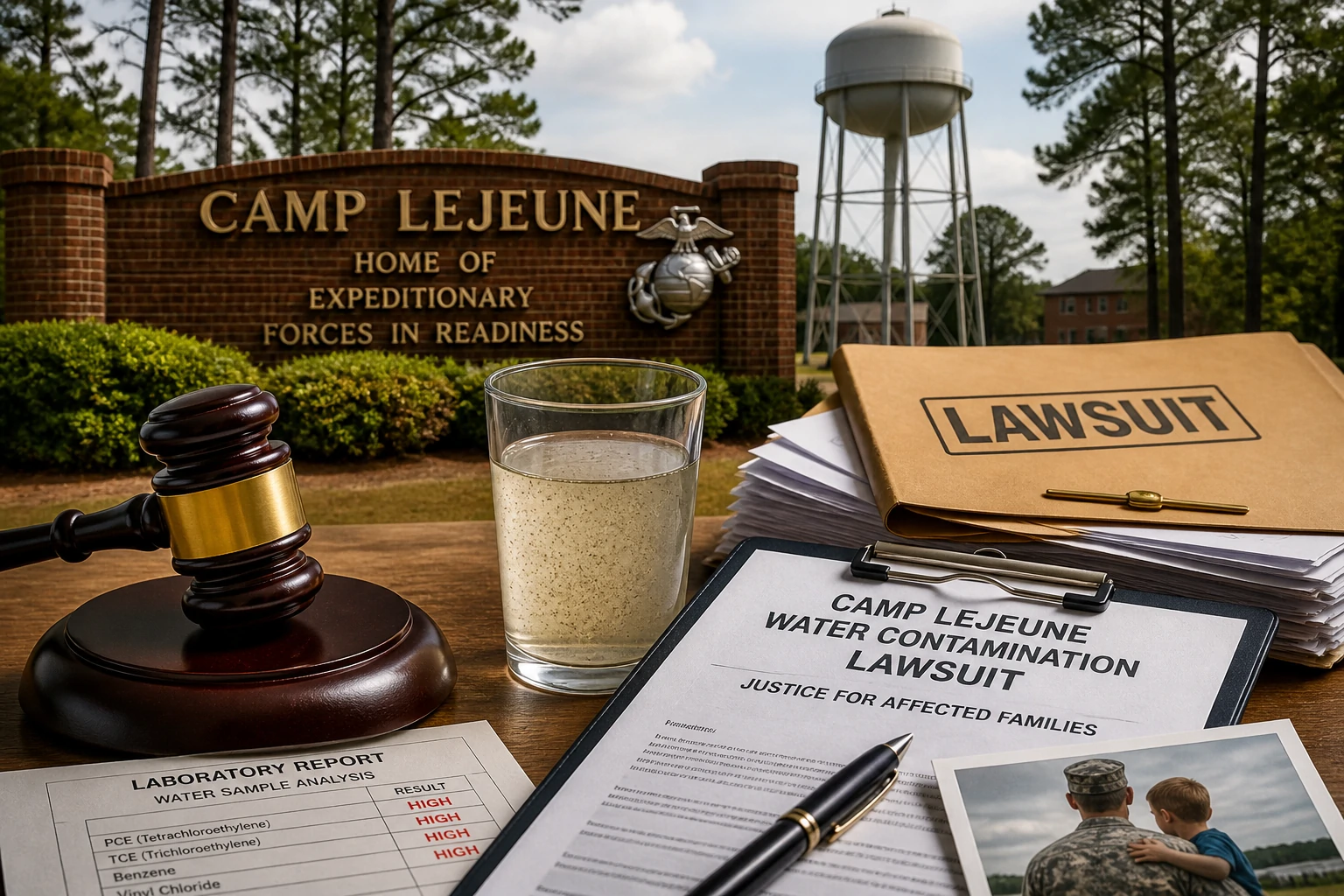
The Camp Lejeune lawsuit is one of the largest toxic water legal cases in U.S. history. It centers on people who lived, worked, or served at Camp Lejeune in North Carolina and later claimed serious harm from contaminated water. Many veterans, family members, civilian workers, and estates filed claims under the Camp Lejeune Justice Act.
This guide explains the latest Camp Lejeune lawsuit update, who may qualify, how the Camp Lejeune water contamination lawsuit works, and what people should know about possible settlement amounts. It also explains what proof matters most, because this case depends on records, dates, illness history, and exposure facts.
Quick Case Snapshot
| Key Point | Current Detail |
|---|---|
| Main law | Camp Lejeune Justice Act of 2022 |
| Exposure period | August 1, 1953 to December 31, 1987 |
| Minimum presence | At least 30 days |
| New claim deadline | Passed on August 10, 2024 |
| Main agencies | Department of the Navy and Department of Justice |
| Current status | Claims review and settlement offers continue |
The Navy states that the CLJA filing deadline has passed, so it no longer accepts new claims. People who filed by August 10, 2024 can still use the claims portal to track status, upload proof, and answer claim-specific requests. The Navy also says its Camp Lejeune Claims Unit is reviewing claims and issuing settlement offers to claimants who submit support documents.
Official Sources Used
This guide uses official records from the U.S. Navy Camp Lejeune Claims Unit, the U.S. Department of Justice, and the Congress.gov text of the Camp Lejeune Justice Act. These sources confirm the law, CLJA deadline, claim review process, and settlement update.
What the Camp Lejeune Lawsuit Is About
The Camp Lejeune lawsuit is about water contamination at Marine Corps Base Camp Lejeune. People claim they drank, bathed in, or used water that contained toxic chemicals. Many later faced cancer, kidney disease, Parkinson’s disease, blood disorders, birth defects, or other serious health issues.
The Camp Lejeune Justice Act gave certain people a legal path to file claims against the U.S. government. This law became part of the PACT Act in 2022. It allowed eligible people to seek relief if they had exposure at Camp Lejeune and later suffered harm linked to the contaminated water.
This case is not a normal class action in the simple sense. Each claim still depends on personal facts. A person must show presence at Camp Lejeune, a related illness or injury, and proof that supports the claim.
Camp Lejeune Lawsuit Update
The most important Camp Lejeune lawsuit update is that new CLJA claims are now closed. The deadline passed on August 10, 2024, so people who did not file before that date may not be able to start a new claim through the Navy process.
The Department of Justice reported that, as of April 16, 2026, Camp Lejeune Justice Act settlement offers exceeded $794 million, and settlement payouts exceeded $543 million. The payout process has moved forward, but many claims can still take time because the Navy may review medical records, exposure proof, service records, work records, and other support documents.
Camp Lejeune Lawsuit Timeline
| Date / Period | What Happened |
|---|---|
| 1953 to 1987 | People lived, worked, or served at Camp Lejeune during the covered exposure period. |
| 1980s | Contaminated wells were identified and removed from service. |
| 2022 | The Camp Lejeune Justice Act became law as part of the PACT Act. |
| August 10, 2024 | The deadline passed for new CLJA claims. |
| 2026 | Filed claims continue through review, settlement offers, payouts, and court steps. |
Camp Lejeune Water Contamination Lawsuit: Toxic Water Facts
The Camp Lejeune water contamination lawsuit centers on chemical exposure. ATSDR says some drinking water sources at Camp Lejeune had chemicals such as trichloroethylene, tetrachloroethylene, vinyl chloride, and benzene. These chemicals are often tied to solvents, dry cleaning, metal degreasing, fuel, and industrial use.
Each claim can look different because exposure was not the same for every person. Time on base, water system, age, health history, medical proof, and family status can all affect a claim. Some cases also involve spouses, children, civilian workers, or estates if the exposed person died before the claim was resolved.
Who May Qualify Under the Law
A person may fit the basic CLJA profile if they lived, worked, served, or had exposure at Camp Lejeune for at least 30 days between August 1, 1953 and December 31, 1987. The EO guidance also treats Marine Corps Air Station New River as part of the covered area.
A claimant may need to show:
✅ They lived, worked, served, or had exposure at Camp Lejeune.
✅ They were present for at least 30 days.
✅ Their exposure happened between August 1, 1953 and December 31, 1987.
✅ They have medical proof of a related illness or injury.
✅ They have records that prove presence, health condition, and legal right to claim.
✅ Family members, children exposed in the womb, spouses, and estates may qualify if the facts and documents support the claim.
Camp Lejeune Lawsuit Payout Per Person
Many readers ask about the Camp Lejeune lawsuit payout per person. There is no single payout amount for every claimant. The value depends on the injury, exposure length, proof, death claim status, and whether the claim falls under the Elective Option.
The Elective Option is a faster settlement path for certain qualifying claims. DOJ and Navy guidance lists EO payment amounts from $100,000 to $450,000 based on injury tier and exposure length. Claims that show a qualifying injury caused or helped cause death may receive an added $100,000. The maximum EO offer listed in the guidance is $550,000.
| Exposure Time | Tier 1 Injury | Tier 2 Injury |
|---|---|---|
| 30 to 364 days | $150,000 | $100,000 |
| 1 year to 5 years | $300,000 | $250,000 |
| More than 5 years | $450,000 | $400,000 |
| Death add-on | +$100,000 | +$100,000 |
These figures do not mean every person gets paid. They apply only to certain EO claims that meet the rules. Other claims may settle outside the EO, go through court, or face denial if proof is weak.
When Will the Camp Lejeune Lawsuit Be Settled?
There is no single settlement date for all Camp Lejeune cases. Some people have already received settlement offers or payouts, but others may still wait because their claims need more proof, review, or court action.
A claimant who accepts an EO settlement may receive payment within 60 days or less if all payment documents are correct and complete. Court cases can take longer, so each claim moves at its own pace. A clean record with strong proof may move faster than a claim with missing service records, unclear diagnosis dates, or estate issues.
Proof That Can Support a Claim
Proof is the heart of a Camp Lejeune water lawsuit. A claimant may need records that show where they were, when they were there, what illness they had, and how that illness connects to the claim.
Useful proof may include:
- Military service records, base housing records, or employment records.
- Medical records, test results, diagnosis notes, or doctor letters.
- Marriage certificates, birth certificates, estate papers, or death certificates.
- Pay stubs, tax records, driver’s licenses, or other documents tied to Camp Lejeune.
Reasons Some Claims Take Longer
Some Camp Lejeune claims take longer because old records can be hard to find. Veterans may need service records, family members may need housing proof, and estates may need legal papers that show who can act for the deceased person.
Medical proof can also slow the process because records must show the diagnosis, treatment date, and link to the claimed condition. If a claim does not fit the EO rules, it may need deeper review, more causation proof, or a longer court process.
Reasons Some Claims Take Longer
| Delay Reason | What It Means |
|---|---|
| Old service records | Veterans may need records from many years ago to prove time at Camp Lejeune. |
| Missing housing proof | Family members may need base housing records, address records, or other proof of where they lived. |
| Estate paperwork | Estates may need legal papers that show who can act for the deceased person. |
| Medical record gaps | Records may need to show the diagnosis, treatment date, and link to the claimed condition. |
| Non-EO claim path | Claims that do not fit the Elective Option rules may need deeper review or a longer court process. |
| Extra causation proof | Some claims may need more evidence to connect the illness to Camp Lejeune exposure. |
Fraud Warning for Claimants
The Navy warns that the Justice Department and Navy will never ask claimants for money or payment. It also says that if an attorney represents a claimant, the agencies will contact the attorney instead of the claimant. Emails from the Navy should come from an official Navy domain, and people can verify uncertain contacts with the Camp Lejeune Claims Unit.
This warning matters because large settlement programs often attract scams. Claimants should not send personal details, bank details, or money to unknown callers. A real claim update should come through the official portal, the claimant’s lawyer, or a verified government contact.
People should also be careful with websites that promise exact payouts. No site can know a person’s final result without claim records, medical proof, and settlement status.
The Smart Takeaway for Claimants
The Camp Lejeune lawsuit is now in a major review and settlement phase. New CLJA claims are closed, but filed claims may still need proof, review, settlement offers, or court action.
The best step is to focus on documents. Service records, work proof, housing records, medical files, birth certificates, death certificates, and estate papers can all help support a claim. Readers should rely on Navy and DOJ records first, use the official portal if they filed on time, and avoid anyone who promises a guaranteed payout.
Common Questions Users Ask
Q. What should I do if my claim is already filed?
Keep your claim records safe and watch for official requests from the Navy, DOJ, or your attorney. Add support documents only through a verified claim channel.
Q. Can missing records hurt a Camp Lejeune claim?
Missing records can slow a claim or make review harder. A claimant may need alternate proof, such as housing records, tax records, pay stubs, family records, or medical files.
Q. Are Camp Lejeune claims handled as one big class action?
Each claim depends on personal facts. Exposure time, illness, records, and legal status can affect review, settlement value, and claim path.
Q. What makes a Camp Lejeune claim stronger?
A strong claim has clear presence proof, medical records, diagnosis dates, and documents that connect the claimant to the exposed person. Clean records make the review easier.
Q. Should claimants trust payout estimates online?
Online payout estimates can be misleading. Official sources and claim-specific records matter more than broad settlement guesses.
Q. How can claimants avoid Camp Lejeune scams?
Claimants should avoid anyone who asks for money, bank details, or personal data through random calls or emails. Official contact should come through the claims portal, DOJ, Navy, or a verified attorney.