
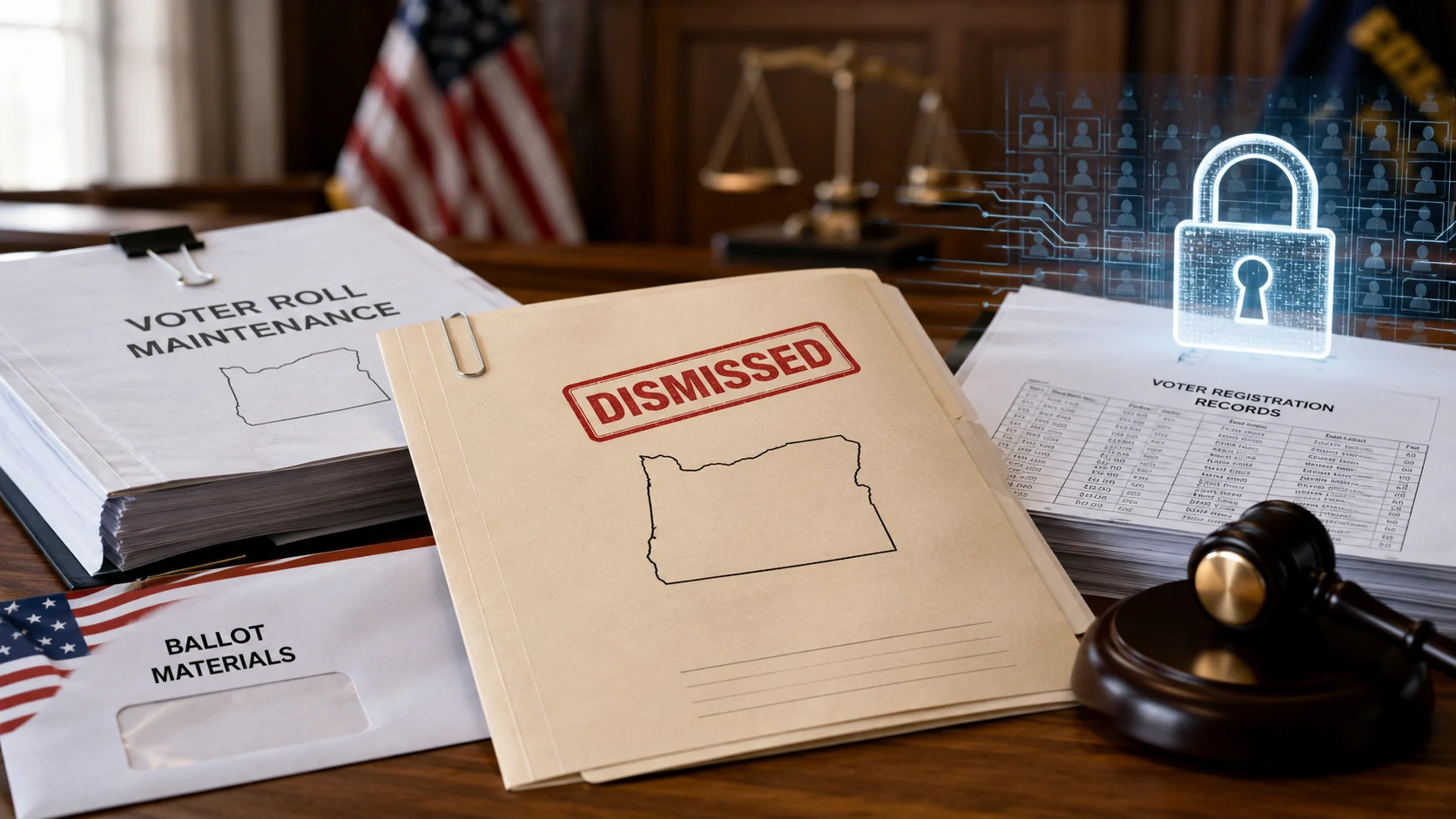
A federal judge’s dismissal of the Oregon voter data lawsuit put voter privacy back in the spotlight. At the center of the case was a Justice Department request for Oregon’s full voter rolls, which raised serious questions about private voter information, state election authority, and the limits of federal access to election data.
Oregon’s voter roll debate did not end with that ruling. A separate case about inactive voter records later ended through a settlement. That case dealt with voter list maintenance, not the same DOJ demand for complete voter data. This difference matters because one dispute focused on privacy and federal reach, and the other focused on how Oregon updates its voter rolls.
Quick Case Summary
This short summary explains the main point of the dismissed Oregon voter data lawsuit and how it differs from the separate voter roll settlement.
| Key Point | Clear Details |
|---|---|
| Main issue | The Justice Department sought access to Oregon’s complete voter rolls. |
| Court result | A federal judge dismissed the DOJ voter data lawsuit. |
| Privacy concern | Complete voter rolls can include personal voter details, so privacy became a central issue. |
| Separate case | Oregon later settled a different voter roll maintenance lawsuit tied to inactive voter records. |
| Key law | The separate settlement involved voter list duties under the National Voter Registration Act. |
Oregon Voter Data Case Basics
Oregon’s dismissed voter data lawsuit involved a Justice Department effort to obtain the state’s complete voter rolls. League of Women Voters said those rolls contained private voter information, and a federal judge dismissed the DOJ lawsuit on January 27, 2026. Privacy advocates welcomed the ruling and said it helped protect Oregon voters’ personal information.
This dispute raised a basic question: who should control state voter data? Election systems in the United States rely heavily on state and local officials. States manage voter registration, ballot access, election rules, and list maintenance. Federal agencies can enforce voting laws, but state officials still handle most daily election duties.
Privacy groups and voting rights groups argued that broad access to full voter rolls could harm public trust. Voter files can include names, addresses, status data, and other personal details that people may not expect to face broad federal use. That concern made the case more than a technical court fight.
Voter Privacy Became the Core Issue
Voter privacy became one of the strongest issues in the dismissed lawsuit. Voting rights and civil rights groups argued that private voter data needs clear protection, especially when a request seeks complete state voter rolls.
This does not mean voter rolls must stay private in every case. Many states allow limited access under state law, but that access usually has rules. The real issue is how much data a requester can get, who can receive it, and what legal reason supports the demand.
Oregon’s Separate Voter Roll Settlement
A separate Oregon election case ended through settlement, not dismissal. That lawsuit accused the state of failing to remove some inactive voters from its voter rolls in the proper way. As part of the settlement, Oregon’s Secretary of State agreed to share certain voter roll data with the plaintiffs each year for five years.
This case was not the same as the dismissed DOJ voter data lawsuit. It focused on list maintenance, inactive voter records, and Oregon’s duties under the National Voter Registration Act. It did not restart the DOJ case, and it did not prove widespread voter fraud in Oregon.
Public reporting also noted that the plaintiffs’ attorney said the group had no proof of widespread voter fraud in Oregon or anywhere else. The attorney said the case was about compliance with voter list rules. That detail helps readers understand the settlement without turning it into a false fraud claim.
Did the Oregon Voter Data Lawsuit Prove Voter Fraud?
Oregon’s voter data lawsuit did not prove voter fraud. The dismissed case focused on the Justice Department’s request for Oregon’s full voter rolls and the privacy concerns tied to that request. A separate Oregon voter roll case later ended through settlement, but it dealt with inactive voter records, notice rules, and list maintenance duties. Both cases were about voter data and voter roll rules, not proof of widespread illegal votes.
Voter Data Access vs. Voter Roll Maintenance
Voter data access means a person, group, or agency seeks voter records from the state. In the dismissed DOJ case, the concern was whether the federal government could get Oregon’s complete voter rolls. That request raised privacy concerns because voter files can contain names, addresses, voter status, and other personal details.
Voter roll maintenance is different. It means the state must keep voter lists accurate through legal steps. This can include address updates, inactive voter notices, and removal of voters who no longer qualify. Oregon’s separate settlement dealt with this process, not the DOJ request for full voter data.
Dismissed Lawsuit vs. Settled Lawsuit
| Issue | DOJ Voter Data Lawsuit | Voter Roll Maintenance Case |
|---|---|---|
| Main focus |
Data Access Full voter roll data request |
List Updates Voter list maintenance |
| Result | Dismissed by a federal judge | Settled in 2026 |
| Core concern | Privacy and federal reach | Inactive voter removal rules |
| Best description | Privacy case | List maintenance case |
National Voter Registration Act and Oregon’s Voter Rolls
The National Voter Registration Act, often called the NVRA, plays a key role in voter roll disputes. It requires states to keep voter registration lists accurate, but it also protects eligible voters from unfair removal. That balance matters because states must remove ineligible records through proper notice and legal process.
Oregon’s later settlement dealt with this list maintenance side of the law. The dismissed DOJ voter data lawsuit focused more on the demand for complete voter rolls and voter privacy concerns. Readers should keep these two cases separate because they dealt with different legal issues.
Oregon’s Inactive Voter Issue
Oregon’s inactive voter issue became public because many voters stayed listed as inactive for years. Public reports said Oregon had about 800,000 inactive voters in its system, and some had been inactive for nearly a decade or longer. Oregon also had about three million active registered voters.
The issue traced back to notice language. Oregon changed the wording on voter notices in 2017. The new wording removed language that told voters their registrations could be canceled if they did not respond or vote in later federal elections. State officials said that change made it harder to legally remove those inactive records.
Oregon officials later directed counties to cancel around 160,000 registrations that had stayed inactive since 2017. They also moved to update notice language so the remaining inactive records could face proper action in the future.
Key Points to Remember
- The Oregon voter data lawsuit dismissed by a federal judge focused on the DOJ’s attempt to obtain complete voter rolls.
- A separate Oregon lawsuit about voter list maintenance ended through a settlement in 2026.
- Voter privacy and voter roll accuracy can both matter at the same time.
- The NVRA requires list maintenance, but it also protects voters from improper removal.
- Public reports did not show proof of widespread voter fraud tied to the Oregon settlement.
Broader Impact Beyond Oregon
Oregon’s case shows how voter data has become a national concern. States must keep voter rolls accurate, but they also need to protect personal voter information from broad or unclear requests.
Other states may face similar fights in the future. The dismissal supports stronger privacy limits, and the separate settlement reminds states to keep voter list rules clear and lawful.
Final Takeaway
Oregon’s voter data lawsuit was mainly about voter privacy, federal reach, and access to complete voter rolls. A federal judge dismissed the DOJ case, which showed that broad requests for voter data need strong legal grounds and clear limits.
A separate Oregon voter roll case ended through settlement and focused on inactive voter records, notice rules, and list maintenance under federal law. It did not prove widespread voter fraud. Both cases point to the same lesson: election systems must protect voter data, keep voter rolls accurate, and follow clear legal rules at every step.
Common Questions
What information can appear in a voter roll?
A voter roll can include a voter’s name, address, voter status, party record where state law allows it, and other registration details. Each state sets its own rules on what parts of that record may be public or limited.
Can the federal government ask a state for voter records?
Federal agencies can seek election records when a law gives them authority. A state can still challenge a broad request if it believes the demand goes too far or lacks a proper legal basis.
Does a dismissed lawsuit erase the public debate?
A dismissal ends that lawsuit, but it does not always end the larger policy debate. Voter privacy, federal access, and list accuracy can still remain public issues after a court case closes.
What is an inactive voter record?
An inactive voter record usually means election officials could not confirm a voter’s current address or status through normal notice rules. It does not automatically mean the voter did anything wrong.
Can a voter be removed from the rolls without notice?
Federal law gives voters certain protections before removal in many cases. Election officials often need proper notice, time, and a legal reason before they cancel a registration.
Why do voter roll cases often cause confusion?
Many people mix voter data access, voter roll updates, and fraud claims into one issue. These are separate topics. A case about records or list rules does not automatically prove illegal voting.
How can Oregon voters check their registration?
Oregon voters should use the official state election website or their county election office. That helps voters confirm their status, update an address, and avoid problems before an election.