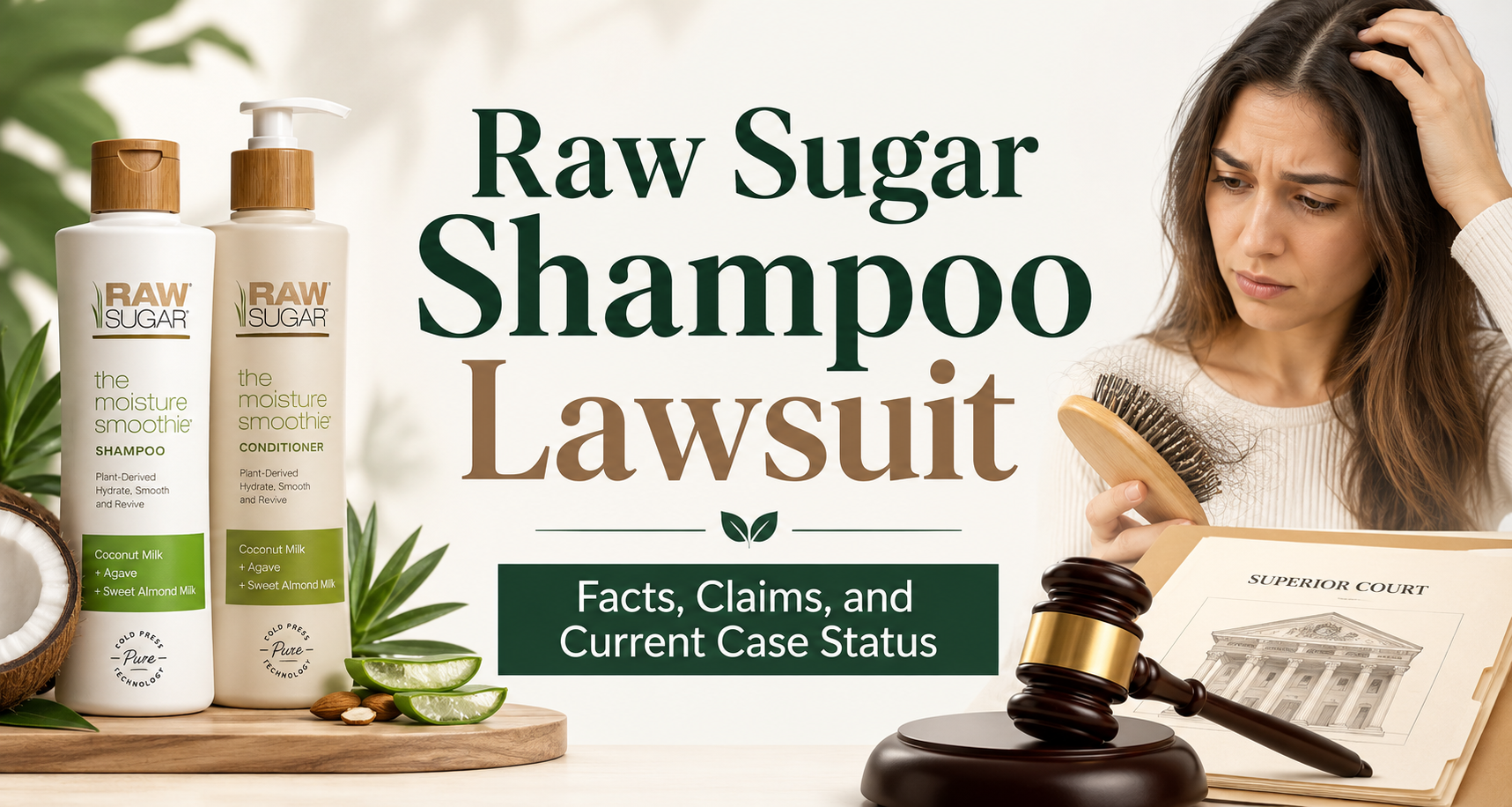
Raw Sugar shampoo has drawn attention after customers shared concerns about hair loss, scalp dryness, breakage, and irritation. These reports have led people to search for information about a possible lawsuit, recall, or settlement. Online posts can make the issue seem larger or more advanced than it really is, so it is important to separate customer experiences from verified court records.
A federal lawsuit was filed against Raw Sugar, LLC and Sugar Buyer, LLC in May 2025. The case focused on product labels and advertising claims rather than a proven link between Raw Sugar shampoo and hair loss. The plaintiff dismissed the complaint in June 2025 before a judge ruled on the claims or approved a class action. No verified settlement, payout fund, or claim deadline resulted from that case.
Quick Answer
A proposed class action called Corona v. Raw Sugar, LLC et al. was filed on May 13, 2025, in the U.S. District Court for the Southern District of California. The complaint focused on product labels and advertising claims. It did not claim that Raw Sugar shampoo had been proven to cause hair loss, scalp burns, or another physical injury.
Maria Corona voluntarily dismissed the complaint without prejudice on June 20, 2025. The court did not approve a class, rule on the allegations, or create a settlement fund. This means there is no verified payout program, claim form, or payment deadline linked to this case.
| Question | Verified answer |
|---|---|
| Was a lawsuit filed? | Yes, in May 2025 |
| Did it focus on hair loss? | No. It focused on product labels and advertising |
| Is the case still active? | Public records show it was dismissed in June 2025 |
| Was a class approved? | No |
| Is a settlement available? | No verified settlement or claims process exists |
Readers should be careful with websites that describe this as a large hair-loss lawsuit or promise compensation. A reliable update should include the court name, case number, filing date, and a link to an official court record.
Claims Raised Against Raw Sugar
Maria Corona claimed that Raw Sugar’s product labels gave buyers a misleading idea about how its products were made. Her complaint focused on phrases such as “cold pressed” and “crafted with LOVE in Southern California.” She argued that customers could read these claims as a sign that products were made in Southern California with local ingredients, even though certain materials or ingredients may have come from other places.
The complaint also questioned whether the words “cold pressed” gave an accurate picture of the full production process. Such claims can fall under consumer protection and advertising law when a label creates an impression that may not match product details. However, filing a lawsuit does not prove that a company broke the law. The case ended before a judge reviewed all evidence or decided whether an average buyer would find the labels misleading.
Why Was It Called a Proposed Class Action?
A class action allows one person or a small group to bring claims on behalf of other customers with similar concerns. In this case, Maria Corona sought to represent buyers who may have purchased Raw Sugar products after seeing the same label statements. However, filing a complaint does not automatically create an approved class action.
A judge must first review the facts, legal claims, and possible customer harm before certifying a class. That step never happened because Maria Corona dismissed the case early. No approved claimant group, settlement fund, or claims process was created, so consumers cannot request payment from this lawsuit.
Current Status of Corona v. Raw Sugar
Maria Corona filed Corona v. Raw Sugar, LLC et al. on May 13, 2025, in the U.S. District Court for the Southern District of California. Court records list Raw Sugar, LLC and Sugar Buyer, LLC as defendants. However, case activity ended soon after it began. Corona filed a notice of voluntary dismissal without prejudice on June 20, 2025.
A dismissal without prejudice does not decide whether the claims were true or whether Raw Sugar broke any law. It usually leaves open a limited chance to file similar claims again, subject to legal deadlines and other rules. No judge ruled on the label allegations, and Raw Sugar did not admit fault. Public sources reviewed for this article do not show a later verified case, approved class, settlement fund, or payment deadline linked to this complaint.
Was Hair Loss Alleged in the Lawsuit?
Court records do not describe this case as a hair-loss lawsuit. Claims focused on product labels, origin statements, and advertising. Online reviews from customers who reported shedding, dryness, breakage, or scalp discomfort are separate from the legal case and do not prove that Raw Sugar shampoo caused those problems.
Hair loss can have several causes, including stress, illness, hormones, medication, heat damage, tight hairstyles, poor diet, or scalp conditions. Symptoms that appear after a product change do not confirm a direct link. A dermatologist can examine the scalp, identify whether hair is breaking or shedding, and check for other possible causes.
Can Raw Sugar Shampoo Cause a Personal Reaction?
No court decision has confirmed that Raw Sugar shampoo causes hair loss. The lawsuit did not produce any public ruling that linked the product to hair shedding, breakage, or scalp damage.
A person can still react to a hair product. Fragrance, preservatives, cleansers, plant extracts, or other ingredients may irritate sensitive skin. One customer may notice dryness or itching, even when another person has no problem with the same formula.
Hair loss needs a proper medical diagnosis because scalp irritation, breakage, and shedding are different issues. Anyone who notices sudden hair loss, bald spots, swelling, burns, sores, or severe itching should stop use and speak with a qualified doctor.
How Product Label Claims Were Viewed
Raw Sugar promoted its products with wording that suggested a special extraction method and a close link to plant-based ingredients. The complaint argued that buyers could understand those statements as a description of how the whole shampoo was made, even if the process applied only to selected extracts.
Courts often review the full package, nearby wording, ingredient list, and other product details to decide whether a label may mislead buyers. No final decision was made in this case because the complaint was dismissed before a judge reviewed the full evidence.
Are Synthetic Ingredients Illegal in Shampoo?
Synthetic ingredients are not automatically harmful or illegal. Shampoo formulas often include plant extracts, cleansers, fragrance, preservatives, and conditioning agents. Safety depends on the ingredient, amount used, product quality, and a person’s skin or scalp response. A plant-based label also does not mean every part of a formula comes directly from plants.
A legal issue may arise when packaging gives buyers an impression that product details do not support. Claims such as “natural,” “clean,” or “plant-based” depend on the exact wording and full label context. Buyers with sensitive skin or known allergies should review the ingredient list before use.
Was Raw Sugar Shampoo Recalled?
As of July 20, 2026, no Raw Sugar shampoo recall was found in the FDA recall notices reviewed for this article. This does not prove that every person will tolerate the product, since irritation or an allergic reaction can still occur. Consumers should check the exact product name, size, lot number, and recall date before trusting a recall claim shared online.
What Should You Do After a Bad Reaction?
Stop use if a shampoo causes burning, swelling, strong itching, rash, or sudden hair problems. Wash away any product left on hair or scalp with clean water. Avoid adding several new treatments at once because that can make it harder to identify what caused symptoms.
Keep useful evidence if symptoms continue:
- Shampoo bottle, box, receipt, and order record
- Lot number and product name
- Photos of scalp, rash, hairline, or damaged hair
- Dates of product use and symptom changes
- Medical notes, tests, and treatment records
Contacting a doctor should come before legal action when symptoms affect health. A medical record may also help show when a problem began and what condition was found.
Consumers can report a reaction to Raw Sugar or to an official product safety authority. A report does not guarantee a recall, but it creates a record that regulators can review.
When a Consumer May Have a Claim
A consumer may speak with a lawyer if a product appears to have caused a serious injury or if a label led to financial loss. A label claim may require proof that the buyer saw a specific statement, relied on it, and purchased the product because of that claim. Receipts, package photos, online listings, and ads may support the review.
An injury claim may also need medical records, product details, expert input, and evidence that connects use with the reported symptoms. Filing deadlines differ by state and claim type, so a lawyer may also check whether the case remains within the legal time limit.
Is There a Raw Sugar Shampoo Settlement?
No verified settlement came from Corona v. Raw Sugar. No court-approved notice, claim form, payment amount, or settlement administrator appears in public case details.
A real class settlement usually includes:
- Official court name and case number
- Judge-approved settlement notice
- Clear eligibility rules
- Claim filing deadline
- Contact details for a settlement administrator
Pages that promise quick compensation without such details may contain wrong or misleading information. A law firm intake form also does not prove that a settlement exists. Firms often collect case details before deciding whether a claim has legal value.
How to Check Future Lawsuit Updates
Reliable updates should link to a court docket, official filing, government notice, or a statement from lawyers involved in the case. Publication dates also matter because an article may repeat an old complaint after it has already been dismissed. Terms such as “investigation,” “potential lawsuit,” or “claim review” do not mean that a settlement or approved class action exists.
Before sharing any update, check the case name, court, filing date, and case number. Corona v. Raw Sugar was filed in the Southern District of California under case number 3:25-cv-01222-BAS-AHG. A new lawsuit could appear later, but it would need its own complaint, plaintiffs, claims, and court record.
What This Means for You
Public records reviewed for this article do not show an active settlement, approved class, or payment process linked to the dismissed Raw Sugar complaint. The case focused on product labels and advertising claims. It did not establish that Raw Sugar shampoo causes hair loss or scalp damage.
Reports about shedding, breakage, or irritation remain personal experiences unless medical evidence supports a direct link. Anyone with serious symptoms should stop using the product, keep the bottle, receipt, and lot number, take clear photos, and speak with a healthcare professional.
Frequently Asked Questions
Is the Raw Sugar shampoo lawsuit still active?
Public court records show that Maria Corona voluntarily dismissed the case without prejudice on June 20, 2025. No judge ruled on the allegations, and no approved class action continued from that complaint.
Was hair loss part of the Raw Sugar lawsuit?
The filed case focused on product labels, advertising statements, and how buyers may have understood certain marketing claims. It was not filed as a personal injury case that proved Raw Sugar shampoo caused hair loss or scalp damage.
Is there a Raw Sugar shampoo settlement or claim form?
No verified settlement fund, court-approved claim form, payment amount, or filing deadline resulted from the dismissed case. Websites that promise compensation should provide a real court order, case number, and settlement administrator.
Has Raw Sugar shampoo been recalled?
No Raw Sugar shampoo recall was found in the FDA recall notices reviewed for this article. A lack of recall does not mean every person will tolerate the product, since irritation or an allergic reaction can still occur.
What should someone do after a bad reaction?
Stop using the product if it causes burning, swelling, a rash, severe itching, or sudden hair problems. Keep the bottle, receipt, lot number, and clear photos of any symptoms. Medical care can help identify the cause and create a record of the reaction.